Ken Clark
I'll Be Gone in the DarkKen Clark, a detective with the Sacramento County Sheriff’s Department, appears as an investigator unwilling to let old files settle into irrelevance. His search for a suspect in the East Area Rapist case and his later review of records around the Maggiore murders reveal two sides of that persistence: the possibility that an overlooked report contains a lost lead, and the risk that suspicion can harden into certainty before evidence has answered the question.
Identity and Investigative Setting
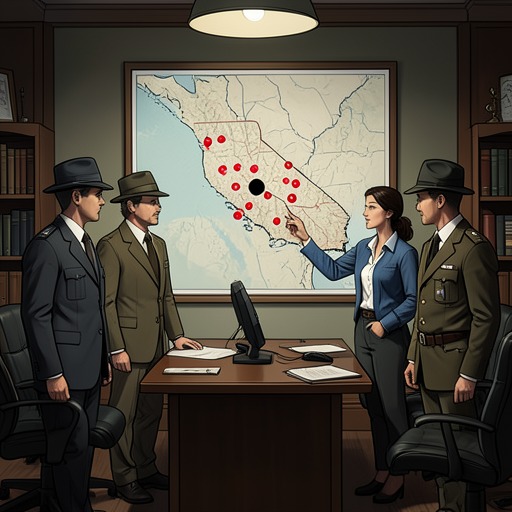
Clark worked in a detective unit pursuing leads during a case that had become a source of community fear. At first, the Sheriff’s Department sought to keep news of the attacks out of the local press, hoping to contain the East Area Rapist’s activity to the east side and catch him there. Investigators followed up on tips, checked with parole and probation officers, and considered people whose routines or presence had drawn neighbors’ attention. The resulting information was often speculative rather than probative, a difficulty that would later shadow Clark’s own suspect work.
The press blackout did not quiet public concern. Rumors, including false claims about the crimes, spread in the absence of official information. After the East Area Rapist attacked twice within twenty-four hours, five hundred people attended a crime-prevention meeting at Del Dayo Elementary School. The next morning, The Sacramento Bee published Warren Holloway’s report that a man was being hunted in connection with eight rapes, ending the blackout. By May 1977, the fear had become material: residents added bars and reinforced panels, deadbolts were back-ordered, and three hundred men patrolled east Sacramento County in pickup trucks with CB radios. This wider climate is the background to the investigators’ work, not a response Clark is individually credited with directing.
The Greer Investigation
Clark and his partner pursued Ron Greer after finding his name in a thirty-year-old supplemental report. Investigators believed the East Area Rapist might have appeared somewhere in the paperwork as a person stopped in traffic or reported under suspicious circumstances. They could not know whether such a name had been overlooked because a suspect’s cover story held up or because an inadequate alibi had been accepted. Greer’s name appeared early in the old reports, making him a candidate for renewed scrutiny.
Surveillance suggested that Greer preferred a particular cigarette brand. Clark and his partner offered him cigarettes, but he declined. Although he was known as a heavy smoker, he also refused to take a sip from a water bottle. The detectives were trying to obtain a direct DNA sample, and Clark read Greer’s guarded conduct as evidence that he understood what they were doing and knew how to avoid leaving forensic material. The episode shows how a striking mismatch between expectation and behavior could intensify Clark’s conviction: Greer’s refusal seemed to confirm, rather than merely complicate, the suspicion already built around him.
Clark and his partner sent the DNA collected from Greer to the crime lab and waited for the result. The account records that the results came back but does not state what they showed. It therefore establishes the test and the detectives’ expectation, not the outcome. That limit matters: Clark’s forceful assessment of Greer is part of the documented investigation, but it cannot by itself establish that Greer was the offender.
The Maggiore Murders and the Old Reports
In a later conversation, Clark stood outside the scene of the February 1978 double homicide in East Sacramento that killed Brian Maggiore and Katie Maggiore. He believed the East Area Rapist had shot the young couple while they were out walking their dog, but the Maggiore murders were never conclusively linked to the attacker. The distinction between Clark’s belief and an established connection remains central to the account.
Clark had recently found police reports describing prowling and break-ins in the area on the night of the murders. The reported activity appeared to move progressively closer to the couple before they were killed. Witnesses had seen the suspect clearly enough for a composite to be released, though the narrative does not establish that the image identified the East Area Rapist. The old reports mattered to Clark because they brought previously scattered events into proximity with the killings, while still leaving the identity of the assailant unresolved.
The files Clark showed included traffic stops and Peeping Tom incidents, material that investigators at the time had not considered relevant. He could not explain why those reports had been set aside, and the omission continued to trouble him. He pointed to a suspect who had been let go on the strength of a relative’s subjective recollection and to another whose description rested on an arbitrary physical impression. These examples expose the unevenness of early screening: potentially useful information could be dismissed, but attention to a report did not automatically make its contents reliable.
Persistence, Suspicion, and Unanswered Questions
Clark’s work is framed by a recurring tension between the missed clue and the misleading one. The old reports offered details that might have mattered, yet the Greer episode shows how behavior interpreted as forensic awareness could become a powerful confirmation of an existing theory. His return to records reflects the conviction that a name or incident might have survived in paperwork even when it had not been recognized at the time. At the same time, the case materials preserve uncertainty rather than converting that conviction into proof.
Questions posed to Clark about the Maggiore murders remain unanswered in the account. They concern whether the homicide had been publicly linked to the East Area Rapist at the time and whether an FBI familial search, reportedly expected to produce 200 to 400 name hits, had produced none. These are questions raised for investigation, not findings Clark is shown confirming. His narrative significance lies in that unresolved space: he keeps examining what earlier investigators overlooked, while the record leaves open whether any particular lead would have yielded the identification he sought.